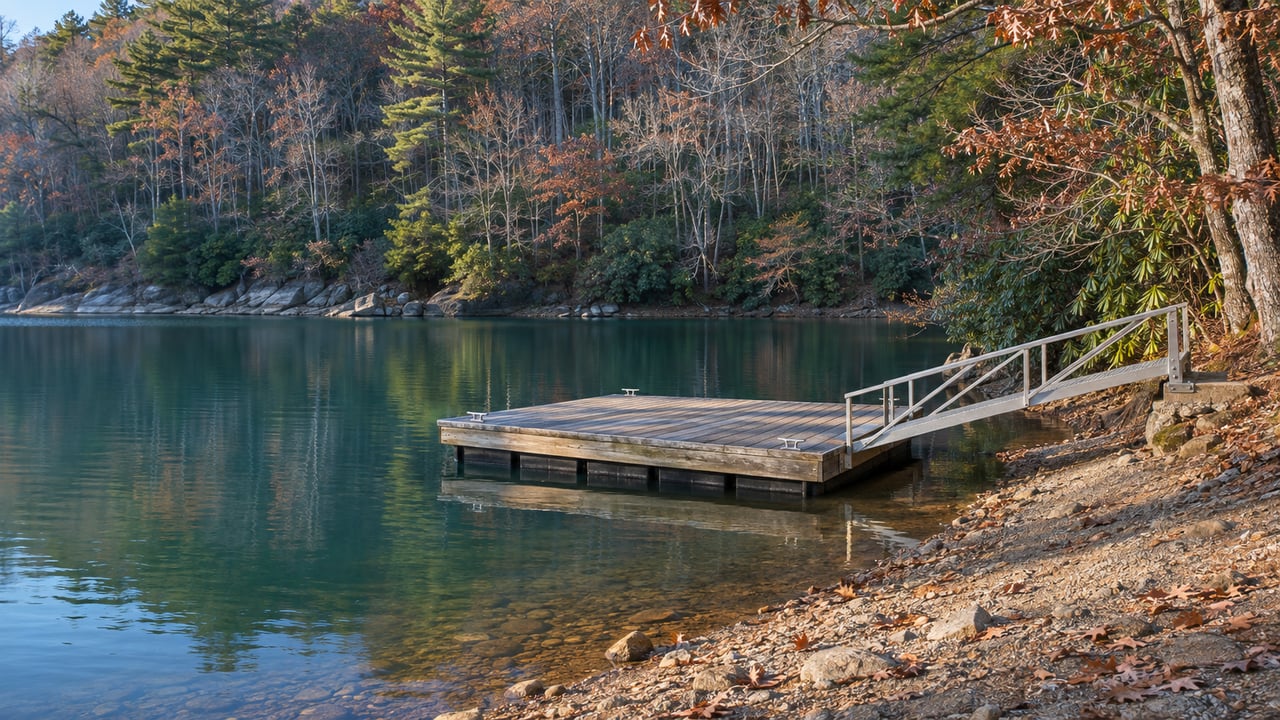
On the night of November 15, 2026, Lake Glenville read 91.32 feet on the reservoir's relative scale. Duke Energy's own lake-level page had shown 91.3 feet at its October 28 update. Both readings put the lake almost nine feet below the 100-foot mark Duke uses for normal full pond. At that level the shoreline in front of a Glenville lot looks different from the July listing photos, and the lake will stay near that level through the end of February.
That makes late fall and winter the most useful time to judge Lake Glenville waterfront. The lake runs below full pond in every month of the year, and from November through February it sits at the bottom of its normal range. A showing in those months shows you the lot at its lowest, with the summer high still to come.
The Lake Never Fills to the Top
Lake Glenville started as an industrial project. Nantahala Power and Light, then owned by ALCOA, began building the dam at Onion Falls in June 1940 to power aluminum production for the war effort. The dam was finished in late 1941, and the valley north of Cashiers filled into what was first called Thorpe Reservoir. The old town of Glenville was evacuated and flooded. Today the Glenville dam holds back a 1,462-acre lake with full pond at 3,491.75 feet above sea level, according to the project's 2011 federal license order.
Duke Energy runs the lake on a monthly target schedule worked out with stakeholders during the West Fork relicensing. Under that operating curve, the target is 97 feet in June and July, 95 feet in August, 93 feet in September and October, and 90 feet from November through February. The lake then climbs to 91 feet in March, 93 in April and 97 again in May.
None of those targets is 100. At its summer high the lake is still three feet below full pond, and for the four winter months it is ten feet below. On Duke's live lake-level page, the October 28 reading listed a minimum of 85 feet and a maximum of 94 for Lake Glenville.
Friends of Lake Glenville gives two reasons for the fall lowering. The lower lake creates storage for heavy runoff during storm season, and it gives owners a window to work on their docks and shoreline. For a buyer, it means that from now until spring you are touring the lake at the bottom of its normal range.
The Dock in Summer Photos and the Dock in Winter
A summer listing photo shows a dock near the top of its year. A showing between November and February, with the lake near its 90-foot target, shows the same dock near the bottom. Note where the end of the dock floats, how the walkway meets the shore, and how far you walk from the house to the water's edge. Those details tell you more about how the slip works across a full year than a July photo does.
The shape of the lake bottom in front of the lot decides how much that ten-foot drop changes things. Lake Glenville is about six miles long with 26 miles of shoreline, and Signal Ridge Marina describes it as more than 100 feet deep. Smoky Mountain Blueways describes the bottom as steep, with 80 feet or more of water a short distance from shore.
Where the bank drops off that sharply, a ten-foot drop in the surface moves the waterline only a short distance out. Where the bottom slopes gently, the same ten feet uncovers much more ground between the house and the water. Two lots that look alike in July can look quite different in January, and a winter visit shows you which kind you are standing on before you make an offer.
In Winter, Boat Access Comes Down to One Public Ramp
The drawdown also changes which public ramps work. The 2011 license order describes three project recreation sites at the Glenville development. The Powerhouse Public Boat Access Area, which the order also calls the "Low Water" access area, sits near the dam. It has a ramp, a dock and parking for about 30 to 45 vehicles with trailers, and it is the site that provides lake access when water levels are low. The Pine Creek Public Boat Access Area, on the northwest corner of the lake, has three ramps, a dock and parking for 40 to 50 trailers. According to the order, Pine Creek cannot be used to reach the lake when water levels are low. The Pines Day-Use Area, just west of the dam, has four picnic tables and parking for up to six vehicles.
A lot near Pine Creek and a lot near the dam can be equally convenient in July and quite different in January. If you plan to trailer a boat, picture the winter drive to the Powerhouse ramp. For the summer side of the lake, see our Labor Day guide to Lake Glenville.
Owners who would rather not handle a boat through the low months have a local option. Signal Ridge Marina's service and storage page lists winterization, shrink wrapping, motor service and in/out service. Its posted rates this fall are $105 per month or $15 per day for storage, $30 for a round-trip in/out launch, and $25 for the ramp fee when you launch your own boat. Those numbers belong in a winter cost estimate next to the dock itself.
What to Ask For Before You Write the Offer
A winter tour shows you the lot at low water. A few documents and questions let you compare it with the rest of the year.
- Ask the sellers for photos of the dock in summer and in winter, taken from the same spot on shore. Comparing them shows how far the waterline moves at this particular lot.
- Write down the date of your visit and check the reading on Duke's lake-level page for that day. Knowing what you saw at 91 feet helps you picture the lot at 97.
- Ask how the sellers used the dock in past winters and whether they kept a boat in the water through the low months.
- Request the dock's paperwork and any records of work done on the dock or shoreline during past drawdowns. Our post on why a Lake Glenville dock isn't automatically yours when you buy covers why that paperwork matters at closing.
- Ask the sellers where they launched or stored a boat in winter. If they used the Powerhouse ramp or a marina, you can price your own winter plan from their answer.
On a July tour the lake covers most of what these questions are about. From now until the water rises toward the 91-foot March target, you can see the answers for yourself. More background on the lake is on our Lake Glenville neighborhood page.
If you're shopping from out of state, ask us about a video walkthrough of a Glenville lot at low water this winter, with the day's Duke reading noted and the seller's seasonal photos gathered into one property package. That way you can judge a lot at its lowest before you see it full. Vignette Realty is ready when you are. Start Your Mountain Story.