Quick answer
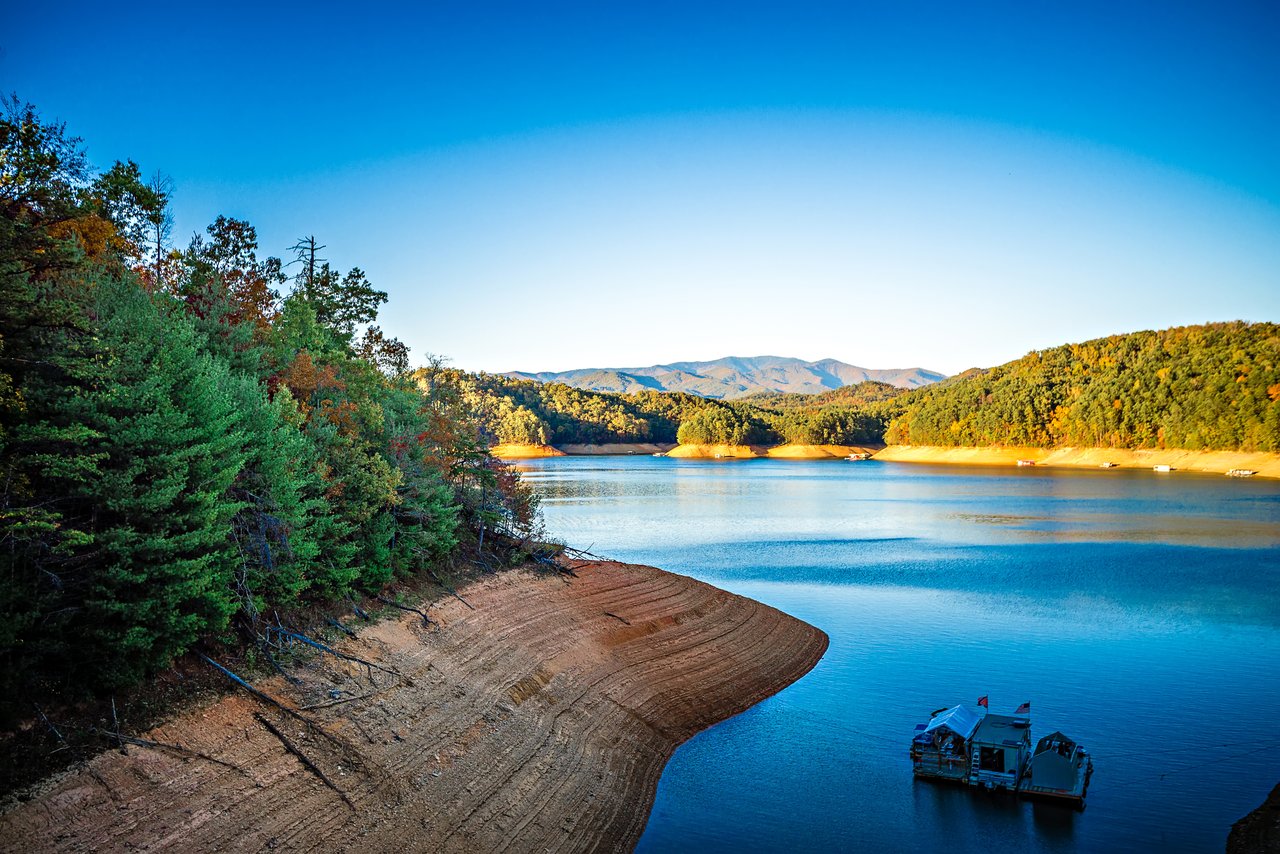
Fontana Lake drops about 56 feet between summer and winter pool in a normal rainfall year, the largest seasonal swing of any reservoir in the TVA system. The drawdown doesn't happen on a single date. Marina slip seasons close September 30, the Fingerlake Day Use Area stays open through October 31, TVA's descent toward winter pool continues into November, and Fontana Village's land-based fall events run on a calendar of their own.
Every year, within a week or two of Labor Day, Fontana Lake starts pulling back from its shoreline. Anyone who has owned a dock here for more than a season knows the feeling. The water that lapped at the top step in July is a foot lower by the equinox, then two feet, then enough that you start eyeing the ramp with a little more caution before you back the trailer in.
What most people who love this lake haven't quite worked out is that the retreat doesn't happen all at once, on one tidy date circled on a calendar. It happens in stages, and each stage belongs to a different business, a different stretch of shoreline, and a different set of people who've built their year around it.
How far Fontana Lake drops, and how that compares
The Tennessee Valley Authority runs Fontana on a summer-to-winter swing steeper than almost anywhere else in its system. TVA's own figure: in a year with normal rainfall, the water level varies about 56 feet from summer to winter to provide seasonal flood storage, against a flood-storage capacity of 514,000 acre-feet.
The maximum controlled elevation is widely misquoted: it is the top of the dam gates, at 1,710 feet above sea level.
Set that against neighboring reservoirs and Fontana stands alone:
Reservoir | Approximate annual drawdown |
|---|---|
Fontana | About 56 feet |
Hiwassee | About 38 feet |
Chatuge | About 9 to 10 feet |
Fontana isn't going through a normal seasonal dip. It's doing the biggest one on the books, and it does it every single year.
Why a 56-foot drop doesn't empty the lake
Here's the detail that keeps it from feeling like a crisis. Fontana is one of the deepest lakes in North Carolina, running to roughly 440 feet at its deepest point in the old river channel, with an average depth near 130 feet, deeper than most other TVA reservoirs. A 56-foot swing sounds enormous until you set it against those numbers.
The main channel and the deep water near the dam barely notice the difference. What actually goes dry are the shallow coves, the boat ramps built for summer depths, and the dock frontage where marinas have staked their business. The fish don't leave. The main body of the lake doesn't disappear.
What changes is access, and access is governed by a handful of very specific calendars that don't all run on the same clock.
When Fontana Lake marina slips close
Alarka Marina, on the Swain County side of the lake outside Bryson City, is one of the largest full-service operations on Fontana, and its boat slip rentals run on a fixed calendar: May 1 through September 30.
That's worth sitting with for a second. The slip season closes at the end of September, right around when the annual drawdown is just getting started. TVA's real descent toward winter pool typically continues into November, meaning Alarka's rental calendar wraps up before the lake has even done half its falling.
That gap between slips closing and the lake bottoming out isn't always gentle. In an unusually dry August in 2007, the docks at Alarka, Greasy Branch and Almond were all pushed to close by Labor Day instead of their more typical early-November wind-down, as marinas raced to move houseboats before they were left sitting on dry ground, according to reporting at the time from Smoky Mountain News. In a normal year, operators don't have to start relocating houseboats until closer to the first of November.
The direction is always the same. Timing depends entirely on how much rain fell that summer.
Where you can still get on the water in October
While slip renters pack it in by the end of September, a different part of the lake keeps going. The Fingerlake Day Use Area, a swimming and paddling spot cut off from motorized traffic, stays open April 1 through October 31, a full month past Alarka's slip season.
The reason isn't complicated. Fingerlake was built for kayaks, canoes, and swimmers, not deep-draft boats sitting in a marina channel, so the first foot or two of the fall drawdown doesn't strand anyone the way it stresses a slip built for a pontoon.
If your fall plans on Fontana involve a paddle rather than a throttle, you've got real weeks of season left after the marina crowd has already called it.
The Fontana Village calendar that ignores the water entirely
Then there's the part of Fontana Village's fall that has nothing to do with water. On October 23, 2026, the resort's Event Center hosts the Fall Rennsport Dragon Rally, a gathering built around driving the famously twisting stretch of US-129 known as the Tail of the Dragon.
The rally sets up beside Quill's Canteen Grill and across from the resort's putt-putt course, and it draws a couple hundred cars for a weekend of mountain driving, not boating. That date lands squarely in the middle of the lake's drawdown window, and it doesn't care in the slightest what the gauge reads.
Fontana Village's fall calendar has always run on more than one clock, and the car side of it is completely indifferent to the water side.
The four Fontana Lake fall calendars, side by side
What it governs | Season | What closes it |
|---|---|---|
Alarka Marina boat slips | May 1 to September 30 | Fixed rental calendar, before the deepest drawdown |
Fingerlake Day Use Area | April 1 to October 31 | Fixed calendar, a month longer than slips |
TVA drawdown to winter pool | Post-Labor Day into November | Rainfall and system-wide storage needs |
Fontana Village events, including the October 23 Dragon Rally | Independent | Nothing to do with lake level |
The 350 homes living on somebody else's timeline
Most day visitors never think about this part. Roughly 350 privately owned floating homes are permanently moored on Fontana Lake, a fact that surprised even TVA when the agency tried, about a decade back, to phase out floating homes across its entire 49-lake system.
Fontana's owners organized as the Fontana Lake Users Association and pushed back hard enough that the counties negotiated a different path: stricter waste rules instead of a ban. Swain and Graham counties secured more than $700,000 in grants to put a fleet of pump boats on the water, so houseboats collecting sewage in onboard tanks could have it hauled ashore on a regular schedule, as detailed in Smoky Mountain News's coverage of the fight.
That infrastructure is the reason the fall drawdown means something different for houseboat owners than for a family renting a pontoon for the afternoon. Several hundred people are timing their last pump-out and their dock adjustments around a narrowing channel, not just watching a gauge for fun. When the lake starts its September retreat, it isn't only marina owners paying attention. It's an entire small floating neighborhood deciding when their access gets tight enough to matter.
Ten things most people don't know about Fontana Lake
The drawdown is the most visible thing about this lake. It is nowhere near the most interesting.
1. The dam is the tallest in the eastern United States. At 480 feet and roughly half a mile long at its widest point, Fontana Dam is the tallest dam east of the Rocky Mountains, and when it was finished, it ranked fourth-tallest in the world. The dam and its associated infrastructure were added to the National Register of Historic Places in 2017.
2. It was built in 36 months, during a war. Construction began January 1, 1942, weeks after Pearl Harbor, and finished in November 1944. Crews worked around the clock in three eight-hour shifts. The dam holds more than 2.8 million cubic yards of concrete, all of it made from rock blasted at a quarry built one mile away.
3. It helped power the atomic bomb. Most of Fontana's output went to the Alcoa aluminum plants about 45 miles away, which produced metal for military aircraft. The rest went to Oak Ridge, where the Manhattan Project was enriching uranium. For years after the war, Fontana's role in that remained secret.
4. There are four towns under the water. Creating the reservoir required buying 68,292 acres and relocating 1,311 families, 1,047 graves and more than 60 miles of roads. The communities of Fontana, Bushnell, Forney, and Judson went under, along with the settlements up Hazel Creek and at Proctor.
5. The entire north shore is national park. Everything across the water from Bryson City is Great Smoky Mountains National Park. No house has ever been built there, which is why Fontana looks the way it does from the water in a way few other lakes in the region can match.
6. The Road to Nowhere is a 1943 promise the government took 75 years to settle. NC Highway 288, the only road linking the north shore communities to Bryson City, went under the lake. The federal government agreed to replace it. They built about seven miles before construction halted around 1970, when newly exposed Anakeesta rock threatened to acidify nearby streams. The road ends at a 1,200-foot tunnel. In 2010, the Department of the Interior settled with Swain County for $52 million instead of finishing the road, and it paid the final $35.2 million installment in July 2018.
7. Families still cross the lake to tend their cemeteries. Park Service staff ferry descendants of displaced north shore families across Fontana for Decoration Days, the Appalachian tradition of cleaning a family cemetery, laying fresh flowers and holding a short service. Descendants formed the North Shore Cemeteries Association in 1978, and the tradition covers more than twenty family cemeteries still standing inside the park.
8. The Appalachian Trail runs across the top of the dam. You can walk or drive it. The shelter on the approach is known to thru-hikers as the Fontana Hilton, for reasons that become obvious after a few weeks of tarps.
9. Low water brings the old world back. When the lake pulls down in late fall, roadbeds, stone walls, foundations, and the occasional rusted car frame surface along the banks. The old NC 288 roadbed survives as the Lakeshore Trail, roughly 34 miles of backcountry route running from the Road to Nowhere tunnel west toward the dam.
10. Jean-Paul Sartre came to look at it. The French existentialist philosopher visited Fontana in early 1945 on a wartime press junket and was astonished by the instant city that had appeared in the wilderness. It is not the sentence anyone expects to read about a reservoir in Swain County.
Reading the fall right
None of this means Fontana Lake shuts down for the winter the way a beach town might. It means the shutdown happens in layers, and each layer belongs to a different piece of the shoreline.
If your plans depend on renting a slip, your season closes at the end of September. If they depend on paddling from Fingerlake, you've got until Halloween. If they depend on watching a couple hundred Porsches take on the Tail of the Dragon, the date on your calendar has nothing to do with any of it.
Knowing which clock actually governs your plans, rather than assuming the whole lake goes quiet on one single date, is the difference between showing up to a closed ramp and showing up exactly when you meant to.
Frequently asked questions
How far does Fontana Lake drop in the winter? About 56 feet in a year with normal rainfall, according to TVA. It is the largest seasonal drawdown in the TVA system.
When does Fontana Lake start dropping? The descent typically begins within a week or two of Labor Day and continues toward winter pool into November. TVA holds levels as high as practical for recreation through the summer, then shifts to flood storage in the fall. The pace varies year to year with rainfall.
When does Fontana Lake refill? The lake typically reaches its lowest point in mid-winter, then recovers as spring rainfall fills the watershed, approaching full pool again by late spring for the summer recreation season.
When do Fontana Lake marinas close for the season? Alarka Marina's boat slip rentals run May 1 through September 30. In drought years, marinas have been forced to close and relocate houseboats as early as Labor Day, as Smoky Mountain News reported in 2007.
Can you still get on Fontana Lake in October? Yes. The Fingerlake Day Use Area stays open through October 31 for swimming and paddling. It is closed to motorized traffic, so the early drawdown affects it far less than it affects marina slips and boat ramps.
How deep is Fontana Lake? Roughly 440 feet at its deepest point in the old river channel, with an average depth near 130 feet. That depth is why a 56-foot seasonal swing changes shoreline access without meaningfully changing the main body of the lake.
How big is Fontana Lake? About 10,230 acres, roughly 29 miles long, with more than 240 miles of shoreline.
What counties is Fontana Lake in? Swain and Graham counties in far western North Carolina. Bryson City is the largest town near the lake's eastern end.
How far is Fontana Dam from Bryson City? About 32 miles, roughly a 45-minute drive, heading west on US-74 and then north on NC-28.
Why was Fontana Dam built? To generate electricity for World War II. Construction began weeks after Pearl Harbor and finished in November 1944. Most of the power went to Alcoa's aluminum plants for military aircraft, with the remainder supporting Oak Ridge and the Manhattan Project.
What should buyers near Fontana Lake know about the shoreline? The entire north shore is Great Smoky Mountains National Park. Anyone buying near the water should confirm both the county's requirements and TVA's shoreline rules before assuming dock rights transfer with the deed.
What towns are under Fontana Lake? Fontana, Bushnell, Forney, and Judson, along with the communities up Hazel Creek and at Proctor. Creating the reservoir required relocating 1,311 families and 1,047 graves.
Where is the Road to Nowhere? It begins in Bryson City as Lakeview Drive and runs about seven miles into Great Smoky Mountains National Park, ending at a 1,200-foot tunnel. It was meant to replace NC 288, which the lake flooded, but it was never finished.
Are there floating homes on Fontana Lake? Yes, roughly 350 privately owned floating homes are permanently moored there. According to Smoky Mountain News's report, owners organized as the Fontana Lake Users Association to defeat a proposed TVA phase-out, and Swain and Graham counties funded pump boats to handle onboard waste instead.
Keep exploring the western lakes and mountain towns
If Fontana pulled you in, these are the places people usually look at next:
- Fontana Lake — what it is like to live on and around the lake, and what comes on the market here
- Bryson City, North Carolina — the closest town to the lake's eastern end, and the base for most of what is in this article
- Nantahala Lake — higher, smaller, and quieter, with a very different water-level personality
- Lake Glenville — above Cashiers, and a useful comparison if you want lake frontage without Fontana's swing
- The Great Smoky Mountains — the park along Fontana's north shore
- The Appalachian Trail near Franklin, NC — the same trail that crosses the top of Fontana Dam
- Sylva and Franklin — the larger service towns within an hour of the lake
- Vacation rentals — if you want to try a season here before you buy
Buying or selling nearby:
- Search every current listing
- What your mountain property is worth
- How buying works here
- Due diligence in North Carolina and earnest money explained, both of which matter more than usual on lake and acreage purchases
- Macon and Jackson County deeds and Macon County maps, the public records tools we use on every land deal
Ready to stop visiting and start staying
Fontana rewards the people who pay attention to it in layers like this, the same way it's rewarded generations of families who've kept coming back to the same cove, the same dock, the same stretch of shoreline year after year.
If this lake and the towns around it ever start feeling less like a place you visit and more like a place you want to belong to, Vignette Realty knows this water and this shoreline as well as anyone. We can tell you which coves hold water in November and which ones don't.
Start Your Mountain Story when you're ready.
This article is general information, not legal, tax or financial advice. Consult a qualified professional about your situation.