Scroll through active land listings around Bryson City this month and one word shows up more than any other: unrestricted. It appears in the headline of tract after tract, often in capital letters, but it addresses private restrictions only. Other site questions may matter too: whether a three-bedroom septic permit has expired, whether soil will support a house, and what elevation a ridge-top homesite sits at.
That distinction can affect whether a land deal in Swain County gets expensive or gets stuck. "Unrestricted" is a real word with a real, narrow meaning. It tells you what a developer or a homeowners association did not impose on the parcel. It tells you nothing about what the county, the state, or in some cases the federal government still requires before you can build.
Why This Word Carries So Much Weight Here
Bryson City's real estate market runs on land more than most mountain towns nearby. Roughly six in ten active listings in the area are raw land or lots rather than finished homes, with land selling at a median around $70,250 as of June 2026, against a home median near $287,500 over the same trailing year. That land-heavy mix is exactly why "unrestricted" gets so much airtime in local listing copy. Sellers know it's the first thing an out-of-state buyer searches for, and it genuinely does mean something: no private covenants dictating home size, no architectural review board, no deed restriction against a barn or a second structure.
What it doesn't mean is that the parcel is a blank slate. North Carolina's building code applies to every residential project in the state regardless of covenants. The state's sediment pollution control rules still matter. County-level permitting still governs construction. And on a meaningful share of Bryson City area land, a federal agency has a say too. None of that shows up in the word "unrestricted." It shows up later, usually during due diligence, sometimes after closing.
The Septic Question Comes First, Not Last
If a parcel doesn't have municipal sewer, and most raw land around Bryson City doesn't, everything else depends on what the soil will support. North Carolina hasn't used a simple perc test, pouring water into a hole and timing the drain, for the underlying evaluation method in decades. The state moved to a soil morphology evaluation, where a licensed soil scientist digs test pits and examines texture, structure, color, and depth to bedrock or hardpan clay across the proposed system area. That gives a more permanent read on what the ground can handle than a single day's drainage rate ever could.
What changed more recently is the rulebook around that evaluation. According to septicandwell.com, North Carolina rewrote its entire septic code effective January 1, 2024, the most significant overhaul of the system in 34 years, altering how soil gets evaluated, how systems get designed, and how permits get issued. The document that comes out of that process, called an Improvement Permit, confirms the property's soil and site conditions can support a system and specifies what type. It's valid for five years. If a seller can hand you a current Improvement Permit, you know the ground works. If they can't, you're gambling on land that might need an engineered system, at real added cost, or in rarer cases might not support any on-site system at all.
That uncertainty matters even on a parcel with no HOA: a septic permit may have lapsed years ago, meaning the soil evaluation has to be redone before anyone breaks ground.
The Elevation Question to Check Beyond the Listing Photos
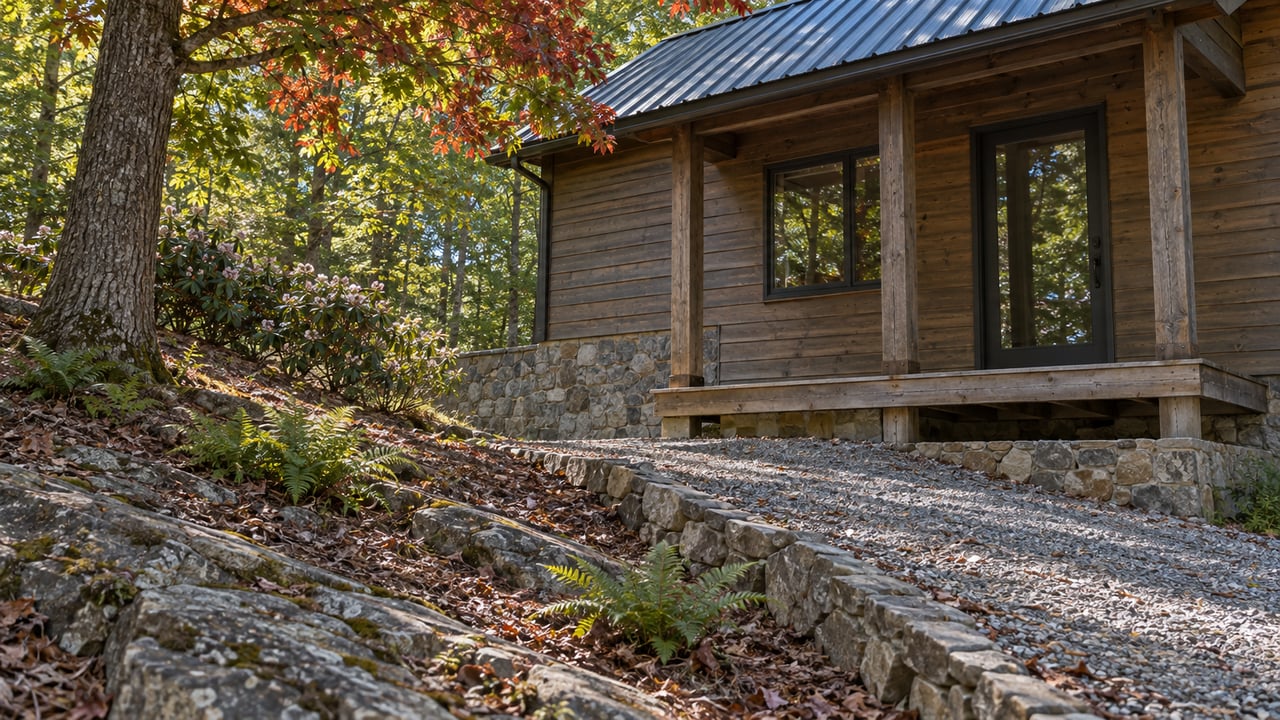
Bryson City sells itself on ridgeline views, and a lot of the acreage on the market leans into that: long-range mountain views, elevated homesites, parcels perched along a scenic ridge. That same terrain is what the North Carolina Mountain Ridge Protection Act was written to address. The law limits structures on protected ridges above roughly 3,000 feet of elevation across 19 mountain counties, Swain among them.
Most building sites in the area sit well below that threshold and never trigger the question. But if a listing is marketing itself specifically on ridge-top elevation and sweeping views, that's precisely the profile worth checking against the county's records before assuming the building envelope you're picturing is the one you're allowed to use.
What Swain County Actually Requires
Once the septic side is settled, the county process itself is straightforward but sequenced, and skipping a step doesn't speed anything up. Swain County's Building Inspections Department requires septic documentation, a tax ID card and parcel number, and a plans review packet before a building permit gets issued. Projects valued over $30,000 require a licensed contractor. Base permit fees run $0.50 per square foot of heated space, with a permit valuation of $91.36 per square foot used to calculate that threshold. The county's building inspections office can be reached directly at 828-488-9134 for current forms and processing questions, and getting that call made early, before a closing date is set, is the difference between a permit that's ready when you need it and a build that stalls waiting on paperwork.
The Fontana Lake Wrinkle
A portion of Bryson City's land inventory borders Fontana Lake, and that proximity introduces a layer that has nothing to do with the county at all. Fontana is a TVA reservoir, and where TVA holds a flowage easement over private shoreline, federal rules under Section 26a of the TVA Act govern what can be built. Any structure on flowage easement land is treated as an obstruction requiring TVA approval, whether that's a dock, a bulkhead, or in some cases a septic system. Where TVA does review a septic system on easement land, it requires a 50-foot horizontal setback and a two-foot vertical separation from the flood guide elevation, on top of whatever the county health department already requires for soil suitability.
Owning land next to Fontana Lake doesn't automatically mean you own buildable lake frontage in the way a buyer coming from a non-TVA market might assume. It means checking, in writing, whether a flowage easement sits between your parcel line and the water before you plan anything permanent near the shore.
| Layer | Who governs it | What it can restrict |
|---|---|---|
| HOA or deed covenant | Private developer or association | Home size, architectural style, land use, rentals |
| County | Swain County Building Inspections and Environmental Health | Septic permits, building permits, plans review |
| State | North Carolina | Building code, septic code (15A NCAC 18E), Mountain Ridge Protection Act |
| Federal | TVA | Structures, docks, and septic placement on flowage easement shoreline near Fontana Lake |
"Unrestricted" only speaks to the first row.
What to Ask For Before You Write an Offer
- Request the parcel's septic status directly. If an Improvement Permit exists, confirm it's still active. If it doesn't exist or has expired, budget time and money for a new soil evaluation before you count on a closing date.
- Ask whether the parcel sits above roughly 3,000 feet on a protected ridge, and if so, confirm with the county what the Mountain Ridge Protection Act allows on that specific site.
- If the land touches Fontana Lake, get written confirmation of flowage easement status before assuming the shoreline is yours to build on.
- Call Swain County Building Inspections early. The septic and building permit steps are sequential, and county scheduling is often the slowest variable in the whole timeline.
A Few Questions We Hear Often
Does "unrestricted" mean I can put an RV or a tiny home on the land? The label alone doesn't settle that. County zoning, septic requirements, and the state building code still apply regardless.
What if the land I want doesn't have a current Improvement Permit? It can still be developable. It just means the soil evaluation hasn't been done or has lapsed, and you won't know the property's real building potential, or the type of septic system it will require, until that step happens. Treat it as a contingency to resolve before closing, not an afterthought for after.
Does bordering Fontana Lake mean I can build a dock? Not automatically. Structures on TVA flowage easement shoreline require a Section 26a permit from TVA itself, separate from anything the county or state requires. Confirm flowage easement status before assuming dock rights come with the parcel.
Land near Bryson City rewards patience more than speed. The parcels that photograph best, ridge views, forest borders, lake proximity, are often the same ones carrying the most layers to verify before a shovel goes in the ground. Vignette Realty walks buyers through that verification before an offer goes in, not after, so the story you're picturing for the land is the one you're actually allowed to build.
This article is general information, not legal, tax or financial advice. Consult a qualified professional about your situation.